Prema / 2026
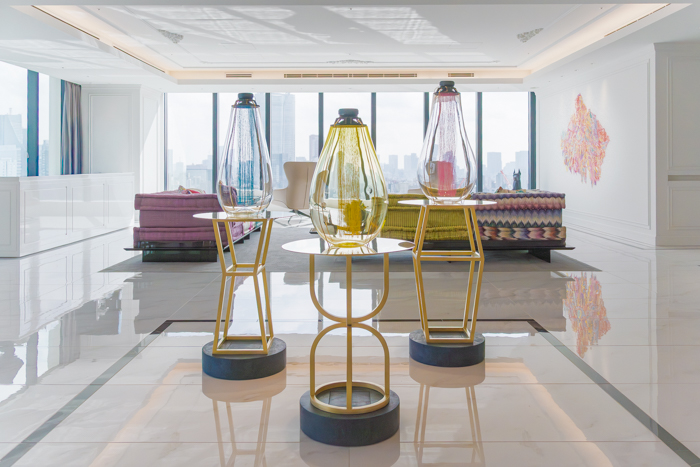


Size : L)H133, W51, D51 / C)H123, W52, D52 / R)H141, W52, D52 cm
This work is a trilogy possessing the energy and structure of human beings as “existence.”
From the speakers at the top of the piece, the heartbeats of a family (husband, wife, and child) are played, while numerous threads visualize the pulse of life. This is also an industrial manifestation of the energy produced by the heart—the organ that governs the “mind and soul.”
With the Sanskrit concept of “Prema” (unconditional love) as its background, this sculpture suggests the relationship between the “heart” and the world by using mirror-finished brass plates to reflect the surrounding environment and the movement of the threads. Furthermore, while the form of the pillars is an homage to the sculptor Brâncuși, it shapes the phenomena of “expansion and contraction” into an open structure, and the deep indigo base at the bottom evokes the imagery of the deep sea.
Humans and life itself rise vertically through time and structure, multi-dimensionally encapsulating “existence” within the work.
「存在」としての人間のエネルギーと構造を持つ三部作
作品上部のスピーカーからは家族(夫・妻・子)の心音が再生され、無数の糸が生命の鼓動を視覚化します。それは、心臓という「心」を司る機関が生み出すエネルギーの現れでもある。
サンスクリット語で「無条件の愛」を意味する「Prema(プレーマ)」を背景に持つこの造形は、鏡面の真鍮板が周囲の世界と糸の動きを反射させることで、「心」と世界の関係性を示唆しています。また、支柱の造形は彫刻家ブランクーシへのオマージュでありながら、「拡張と収縮」という現象を開かれた構造として形づくり、最下部の藍色の台座は私達に深海を想起させます。
人間や生命が時間的、構造的に垂直に立ち上がり、「存在」を多層的に作品へと内包させている。